
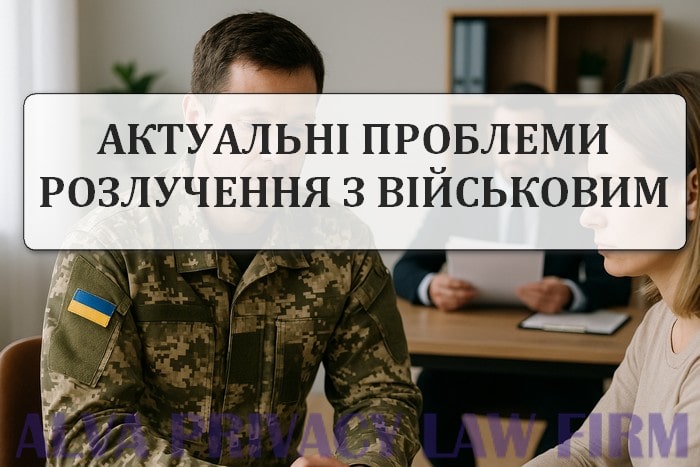
As martial law persists, family disputes in Ukraine most concern the termination of marital relationship in which one of the parties is on active duty in the Armed Forces of Ukraine. Proceeding from the divorce case law, it is still, as in a time of peace, mostly women who initiate a relationship breakup. The trend is just getting going in the time of war. Objective reasons behind this are separation, significant distance between the spouses, inability to be together for long, lack of normal communications that disconnects and sets people apart and a significant change in both spouses' mental and emotional conditions (of course, it is especially so for military members of the Armed Forces of Ukraine).
From a legal perspective, this category of cases has its own specifics stemming both from the rules of procedural law and from objective circumstances of the war and specifics of the military service. Proceeding from our experience of managing such cases, we can say that they are specifically about the parties' participation in the divorce proceedings, choice of jurisdiction, opportunities to participate in the trial remotely and, on a separate note, the suspension of proceedings if the conscript is prevented from attending court sessions.
Mandatory nature of the judicial procedure
If the spouses have minor children in common or one of the spouses does not agree to the dissolution of the marriage, they may not get divorced through the civil registry office, but will have to file a divorce petition with court. This procedure gets even more complicated if a military spouse is involved and such spouse is physically prevented from attending hearings in court because of, among other things, being on a mission in a combat zone.
Choice of jurisdiction
Thus, if we speak of women who (as mentioned above) most often initiate a divorce, a divorce petition against the military spouse acting as the respondent must be filed at such respondent's registered place of residence. This is consistent with the general rule of venue set out in the Civil Procedure Code of Ukraine.
However, the claimant (woman) may, whenever the law so provides, file the petition at her place of residence. Such an opportunity is afforded if there are objective reasons making it difficult for the claimant to apply to court by following the general rule. This does not come without specifics of its own: if so, the claimant must additionally justify the relevant choice by referring to specific circumstances and adding evidence to prove that this is the case.
The right choice of venue (jurisdiction) is of essence for effective resolution of the case. If the petition so filed gives no proper reasoning why the special jurisdiction must be applied, the trial can be consequently delayed (sometimes for several months).
A military member of the Armed Forces of Ukraine participating in the proceedings
Ukrainian legislation provides for several ways to participate in the court trial:
- attending court sessions in person;
- participating remotely by way of video conferencing;
- acting through a representative (under the power of attorney or other formal authorization);
- giving written explanations.
If the respondent, though having been duly notified of the date and time of the court hearing, still fails to appear, the court has the right to pass its judgment in the absence of the respondent (in absentia), unless the respondent gives proper reasoning for such non-appearance.
Furthermore, it is worth noting that the case may stand adjourned more than once because of the respondent's failure to appear. This protracts the trial considerably as the court is required to give the respondent sufficient time to respond; more so if a military member on active service is concerned.
Based on the litigation practice conducted by Alva Privacy lawyers in 2022 to 2025, we can conclude that whenever such circumstances exist (the respondent is known to be on active service in the Armed Forces of Ukraine and does not appear in court nor responds in any manner), most judges adjourn the trial 2 to 3 times on average and, in 1% of cases only, they postpone their judgments more than 4 to 5 times.
If you need more information about the marriage dissolution procedures or are interested in legal services, please see our other pages on this topic.
Suspending the proceedings: legal and factual grounds
Special attention should be paid to the institution of procedural suspension, which has been increasingly used since 2022 in cases involving military service members. Article 251(1)(2) of the Civil Procedure Code of Ukraine explicitly states that a court is required to stay proceedings if a party involved in the case is on active military service in terms of martial law or engaged in combat operations.
However, proceeding from our personal experience, we can state that the conscription as such is not a good reason to suspend the proceedings "automatically"!
As evident from the legal position set forth in the Supreme Court's resolution of 13/3/2025 in case No. 557/1226/23, the proceedings may be suspended only if all of the following conditions are met:
- the military unit in which the respondent serves is put under martial law and directly involved in combat operations;
- the nature of the respondent's military service prevents him from participating in the proceedings;
- the respondent objectively has no opportunity to participate in the court sessions in any manner – either in person, remotely or through a representative.
If these "restrictions" are not applicable, it would be pointless for the judge to suspend the proceedings and such decision may be appealed accordingly. Therefore, the judge must examine actual conduct of the military service member, rather than merely the certificates of military service provided by him, for example, whether he maintains contacts, whether he has instructed an attorney to manage his case, or whether he files procedural documents.
We have already discussed the issue in more detail in the article prepared by Alva Privacy lawyers on the Court Suspending an Alimony Case Involving a Serviceman. We recommend you read this information for in-depth understanding of the matter.
Digitalization of justice: a chance for access but not a universal solution
Thanks to the Unified Judicial Information and Telecommunications System (USITS) that has been put in place, it is now possible to:
- file applications and petitions electronically;
- participate in court sessions remotely;
- communicate promptly with the court via an e-court account.
These tools have partially eliminated the difficulties that concerned the “mobility” of the military service members, though they are not always practically applicable, especially if a person is in a combat zone or subject to military rotation.
Practical recommendations on how to dissolve the marriage with a military member
Contacting a lawyer from the very outset
A qualified lawyer will help you prepare all documents properly, choose a court of proper jurisdiction, and take due account of the specifics relevant to the military service. This will spare your time on attending the proceedings and help avoid procedural errors, such as, for example, wrong choice of court to file an application.
Planning for the trial in view of the military service
Considering that it is hardly predictable whether the military member will participate in the trial or not, you should be ready for possible postponements of court hearings (and potentially multiple ones). Therefore, it makes sense, in the first place, to adjust accordingly your plans, schedules, etc.
Using means of remote participation
If the trial is postponed due to the absence of the military member or because of video conferencing being technically infeasible, or the military member being busy on missions, or at the request of the attorney hired by the military member, so that such postponement results in rescheduling court sessions more than 3 or 4 times, we recommend the claimant to agree with the attorney upon filing applications for hearing the case in the respondent's absence (if possible) or for his participation by way of video conferencing. At the very least, this will save money for the woman claimant and her personal time (as well as the time of her attorney).
Preparing for the potential trial in the absence of the military member
If the military member or newly conscripted person does not appear at the hearing, the court may render its judgment in his absence. It is advisable to consult a lawyer beforehand and discuss this procedure.
Being mentally ready and getting support
From a practical perspective, the process of divorcing a military spouse often brings additional mental pressure to all of the participants, both due to the fact that the person is doing military service and because of the situation in the country, martial law, etc. Getting support from professionals and the loved ones will help you pass through this situation with the least losses possible.
Conclusion
Definitely, divorcing a military spouse is not an easy thing to do, especially in wartimes; it requires precise alignment with procedural rules, proficiency in the current case law prevailing in the field, and an impartial account of actual circumstances surrounding the military service.
The court may stay the proceedings but is not required to do so "automatically" solely because one of the spouses has been conscripted to join the Armed Forces of Ukraine. If there is a real opportunity to participate in the proceedings this becomes a key factor in resolving this procedural issue.
By getting a professional legal assistance, you will be able to defend effectively your rights and interests in such complicated matters. Legal support for divorce cases involving a military spouse often requires true understanding, rather than mere legal knowledge, of the realities that affect the military during martial law and the specifics coming from documenting and confirming the relevant circumstances.
The experts hired by Alva Privacy have practical experience of managing such cases and can assist with the legal proceedings, having taken due account of all of their aspects – both legal and practical. Please feel free to contact us when needed!
Written by Sofiia Ohiievych, Lawyer.